

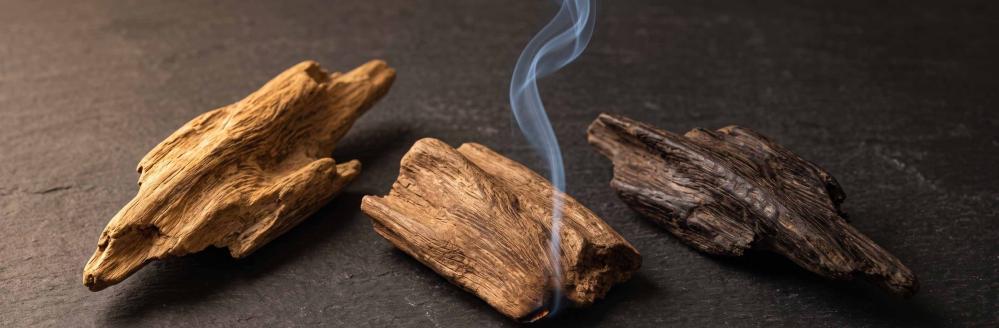
If you've ever burned two pieces of oud from the same batch and noticed they smelled slightly different, you didn't imagine it. And nothing went wrong.
That variation is actually one of the most important things that separates real oud from everything else on the market. Understanding why it happens will change how you experience oud completely.
No Two Pieces Are the Same, Here's Why
Real oud comes from the Aquilaria tree, but only after that tree has been infected by a specific fungus. The tree responds by producing a dark protective resin inside the wood. That resin is what creates the scent.
But here's the thing. Every tree responds differently. The age of the tree, how deep the infection went, how long the resin had to develop, the soil it grew in, the climate of that specific forest, even the season it was harvested, all of these things affect the final scent of every single piece of wood.
Scientists have identified more than 150 aromatic compounds in agarwood. Two main groups of molecules dominate the scent profile, and the balance between them can vary widely depending on the tree and environment. That's why two pieces from the same origin can open differently, burn differently, and leave a different trail in the room.
Two pieces of agarwood can smell very different depending on species, climate, tree age, growing conditions, resin level, harvest method, and post-harvest handling. That variation is part of oud's fascination.
This is not a defect. This is the whole point.
How Oud Changes While It Burns
The variation doesn't only happen between pieces. It happens within a single burn.
Agarwood incense produces a rich, warm, woody scent that shifts as it burns, moving from a sweet, slightly campfire-like opening into deeper notes that can include honey, leather, and earth depending on the grade and origin.
When you first place a piece on the burner, you get the top notes, usually the lighter, more volatile compounds that release quickly with the initial heat. These are often the sharpest and most immediate part of the experience. Some people make the mistake of judging the whole piece from this first minute alone.
Give it time. As the heat builds and the wood settles into a steady burn, the heavier resin compounds begin to release. This is where the real depth of the oud reveals itself. The smoke shifts. The room fills differently. The scent you smell at the ten minute mark is genuinely not the same as what you smelled at the one minute mark.
And then there's what happens after the burn ends. The scent that lingers in the room and in the fabric around you is a different layer again, softer, warmer, and often the most beautiful stage of the whole experience.

Why Origin Changes Everything
Oud oils are often categorized by geographic origin, much like wine. Cambodian oud often smells sweet and fruity. Indian oud can be deep, leathery, and animalic. Thai oud sometimes has green or medicinal nuances.
This is why at Zamaa Imperial we don't just sell oud. We sell oud by origin. Cambodian Super smells nothing like Indian Seeufi. Burmese oud has a completely different character from Laotian. Vietnamese oud from the same region can shift dramatically between harvests.
The reason for this range comes down to chemistry. Agarwood contains two main families of aromatic compounds. One group produces the deep woody backbone of the scent. The other contributes fruity, sweet, and balsamic qualities. The ratio between them varies enormously from one piece to the next.
When you start to notice these differences between origins, you've moved from simply burning oud to actually experiencing it. That's a different thing entirely.
Why Synthetic Oud Smells the Same Every Time
Here's the contrast that makes this point clearest.
Synthetic oud smells identical every single time. Every piece, every burn, every session, exactly the same. That consistency is what makes it cheap to produce and easy to sell at scale. But it's also exactly what makes it hollow.
Natural oud varies in shape and scent from piece to piece. Synthetic oud looks and smells the same across all pieces. If you've ever burned something labeled as oud and found it completely predictable from start to finish, now you know why.
Real oud is unpredictable because it's alive in a way synthetic materials never can be. It was formed by a living tree, in a specific forest, over decades. That history is in the scent. You can't manufacture that in a lab.
How to Get More Out of Every Burn
Now that you understand why oud varies, here's how to actually pay attention to it.
Don't judge the first two minutes. The opening of any burn is the most volatile stage. Give the piece at least ten minutes before you decide how it smells. The smoky character tends to be most prominent in the first few minutes of a session and settles as the session progresses and the room fills with the deeper aromatic character.
Use a lower heat setting. High heat burns through the top notes too fast and you miss the development. On an electric burner, start low and let the temperature rise slowly. This draws out the full range of the piece over a longer time.
Compare pieces from the same batch. Take two chips from the same bag and burn them on separate occasions. Notice what's different. This is how you start to develop a real understanding of oud rather than just a general impression of it.
Pay attention to the room after the burn ends. The residual scent that stays in the fabric and air after the wood stops burning is often the deepest and most refined stage. Don't leave the room too early.
The Honest Truth About Variation
Some people find oud variation frustrating at first. They want to know exactly what they're going to get before they light the piece. That's a completely understandable reaction.
But the variation is the value. A kilo of oud that smells exactly the same from every piece is a kilo of something that was manufactured, not grown. Real oud carries the story of the tree it came from, the forest it grew in, and the time it took to form. No two trees lived the same life, so no two pieces smell exactly the same.
That's not a flaw in the product. That's proof that it's real.
Common Questions
Is it normal for oud to smell different every time?
Yes, completely. Natural oud varies between pieces, between burns, and even within a single burn as the temperature changes. This is one of the clearest signs you have genuine oud.
Why does my oud smell sharp at first but better after a few minutes?
The first minutes of a burn release the most volatile top-note compounds quickly. As the burn settles, the heavier resin compounds come through and the scent deepens. Always give it time before forming an opinion.
Does the burner type affect how oud smells?
Yes. Charcoal burning produces more smoke character than an electric burner. Electric burners give you more control over temperature and tend to draw out the subtler notes more clearly. Neither is wrong, they produce different experiences from the same piece.
Why does the same oud smell different on different days?
Humidity, room temperature, and even what's in the air around you affect how you perceive scent. A dry day in an air-conditioned room will give you a different experience from a warm evening with windows open. The oud isn't changing, your environment is.