

If you've ever seen oud selling for a few riyals and wondered why ours costs significantly more, this article is the honest answer.
The market today is full of oud. Walk into almost any shop and you'll find shelves stacked with wood chips, oils, and bakhoor all labeled as oud. Some of it costs almost nothing. And that's exactly the problem.
Not all oud is the same. In fact, a lot of what's being sold right now isn't really oud at all.
How Real Oud is Actually Formed
Real oud doesn't come from just any tree. It comes from the Aquilaria tree, and only when that tree becomes infected by a specific mold does it begin producing the dark, aromatic resin that makes oud what it is.
Here's the part that explains the price. Natural resin infection occurs in only around 7% of agarwood trees. That means the vast majority of Aquilaria trees never produce oud at all. You can grow a forest of them and most of it will be worthless for fragrance purposes.
And it doesn't happen fast. It takes 20 to 30 years for agarwood trees to produce resin. After all that time, the yield of actual usable wood is small. Then comes the extraction.
The wood is carefully chopped, dried, and then put through a steam distillation process that separates the fragrant oil from the wood. The resulting oil is then aged further, sometimes stored for months or years, to allow the aromatic compounds to mature and develop.
Every step requires skill, time, and patience. There are no shortcuts in this process. That's why genuine pure oud oil can reach extraordinary prices per kilogram, easily surpassing the price of gold.

What Is Enhanced Oud and Why Is It Everywhere
Enhanced oud is real oud wood that has been processed to improve or intensify its scent. It is treated through fermentation or distillation to enrich and deepen its aroma, and it offers consistent quality where each piece smells the same. This isn't necessarily dishonest when it's sold transparently. The issue is when it's sold as pure natural oud at pure natural oud prices.
But the bigger concern is what comes next.
What Is Synthetic Oud and Why You Should Know About It
Synthetic oud has nothing to do with Aquilaria trees. It is often made from white wood infused with additives like resin and methanol, then exposed to specific temperatures to blend the substances into the wood. It's manufactured to look and smell like oud at a fraction of the cost.
Natural agarwood oil contains 367 identified chemical compounds. Synthetic oud recreates the scent profile using a handful of engineered molecules. That's the difference between a full orchestra and someone playing one note on a keyboard and calling it music.
And there are real health concerns. Many synthetic oud perfumes contain phthalates, which are linked to hormone disruption. Some of the chemicals used in synthetic oud may negatively impact health if inhaled frequently. When you're burning something in your home, in your majlis, around your family and children, that matters.

How to Tell the Difference
This is where it gets practical. Here are real ways to spot the difference before you buy.
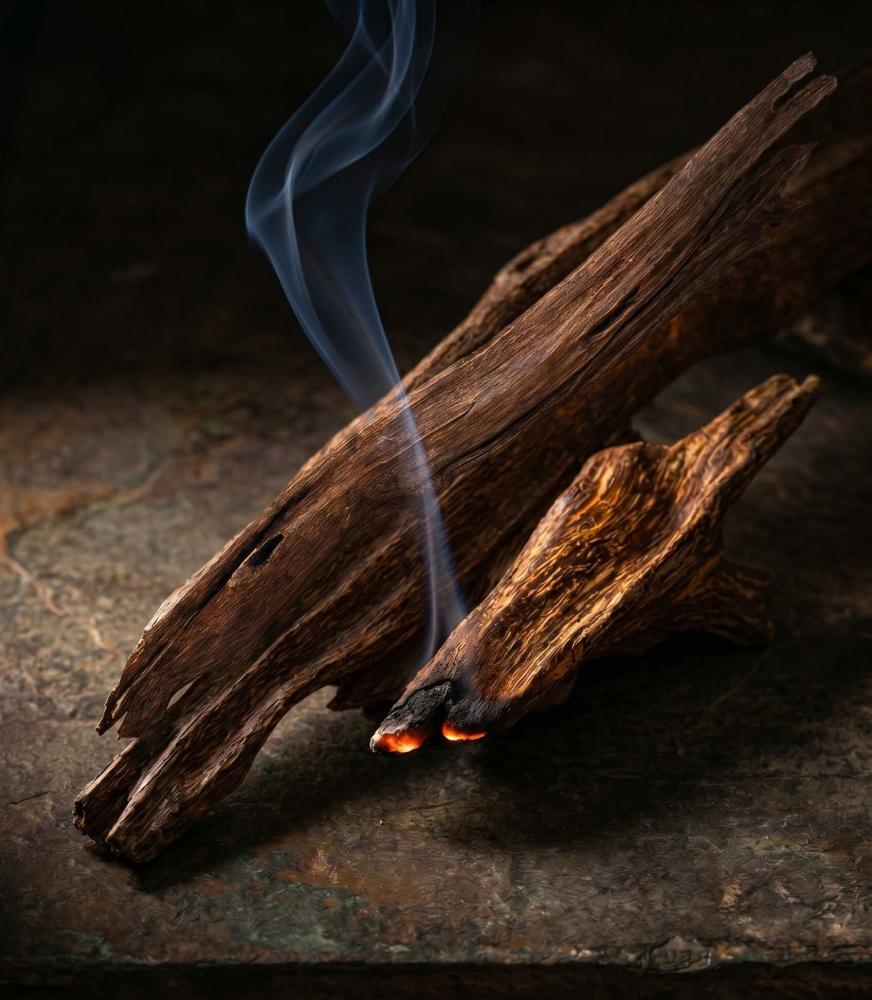
The smoke test. Burning natural oud releases a bluish smoke that lasts longer. Synthetic oud tends to release heavier, harsher smoke.
The scent consistency test. Natural oud varies in shape and scent from piece to piece. Synthetic oud looks and smells the same across every single piece. If every chip in a batch smells identical, that's a sign it's been manufactured rather than grown.
The evolution test. Pure oud has a complex aroma that evolves over time. Synthetic versions often smell linear, flat, or overly sweet. Real oud changes as it burns. It opens differently than it finishes.
The smell test before burning. Natural oud has a distinct earthy scent even unburned. Synthetic oud may have a chemical or alcoholic odor.
The price test. If an oud perfume or oil costs very little and is marketed as pure or genuine, the economics of natural oud simply don't allow for that pricing. If it's extremely cheap, there's a reason.
What We Do Differently at Zamaa Imperial
Every piece of oud wood and every oil we carry is pure and natural. No enhancements, no synthetic blending, no shortcuts. We verify purity and origin before anything reaches our customers.
This is why our prices reflect what genuine oud actually costs to source. It's not a premium for the sake of it. It's the honest price of the real thing.
When you burn oud in your home or apply it to your skin, you deserve to know exactly what you're using. Pure oud has been trusted across the Arab world, South Asia, and East Asia for thousands of years. What's flooding the market today is not that.
Common Questions
Why is pure oud so expensive? Because it's genuinely rare. Only a small fraction of Aquilaria trees ever produce resin, it takes decades to form, and the extraction process is slow and skilled. There's no way to mass produce the real thing.
Is cheap oud safe to burn at home? It depends on what it actually is. Enhanced oud is generally fine. Synthetic oud made with chemicals like methanol or phthalates carries real health concerns, especially with regular use around children or in enclosed spaces.
How do I know if my oud is real? Look for natural variation between pieces, a complex scent that changes as it burns, bluish smoke, and an earthy smell before burning. Buy from sellers who are transparent about sourcing and origin.
Does synthetic oud smell like real oud? It can approximate it on the surface but it doesn't evolve the same way. Real oud changes throughout the burn. Synthetic oud is flat and linear by comparison.